Pages

Showing posts with label Periodic Trends/Wavelengths. Show all posts

Tuesday, March 8, 2016

Unit Afterthoughts

Blog Post #6

Over the course of this unit, I had found the material to be quite simple. I usually question myself multiple times over the many different lectures, but I seemed to rarely do that this unit. When it came to the quiz, I made stupid mistakes that I corrected when I had my quiz returned back to me. However, since I was absent the day we took the test, I'm hoping that with additional days of studying I will be able to fix those last minute jitters that make me overthink the simplest little things. 

Spec20 Lab

Blog Post #5
Earlier this unit, we had conducted a lab using a Spec20 to analyze the transmittance and absorbency at different wavelengths of both Copper and Chromium ions. The lab was a bit tedious and repetitive to go through, having to do the same exact thing but set at different wavelengths. 
Although it was interesting in the process of how to actually use the Spec20, I will probably not use one again, if I do, I will certainly be better prepared in how to use one. 


http://abacus.bates.edu/~ganderso/biology/resources/spec20a.gif

Useful Links:
ChemLab-Spec 20

Sunday, February 28, 2016

Quantum Numbers

Blog Post #4
February 28, 2016

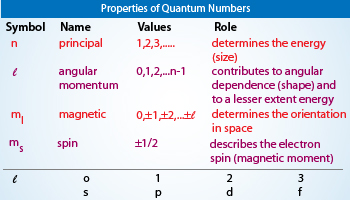
Our third lecture consisted of quantum numbers. These rules closely correlate with the electron configuration rules as well. 

1.) Principle Quantum Number (n): This is the value of the principal energy level. 
2.) Angular Momentum Quantum Number (1): this number is determined from what sublevel it lies in.
3.) The Magnetic Quantum Number:
Runs from -1 to 1, mainly focused on the orbitals. 
4.) The Spin Quantum Number: This number +1/2 for the first electron in an orbital and -1/2 for the second electron in an orbital. 
(KEEP IN MIND ALL PRINCIPLES)

Properties of Quantum Numbers
http://www.wonderwikikids.com/resources/content/imagesv4/chemistry/concept/structure_matter/Atomic_Spectra/AS_Quantum_3.jpg


Helpful Links:
Quantum Numbers and Electron Configuration
Quantum Numbers-Khan Academy


Electron Configuration

Blog Post #3
February 28, 2016

Our second lecture in this unit consisted of electron configurations. 
In writing an electron configuration, there are four levels of organization to describe the location of an electron in any particular atom. 

1.) Principal Energy Level: Describes in very general terms how far away from the nucleus an electron can be found.Represented with n.
2.) Sublevel: There are four different sublevels- s, p, d, f.
Those letters represent the different energy levels, with S being the lowest to F being the highest energy level. 
3.) Orbitals: S=1  P=3  D=5 F=7
4.) Spin: Each orbital can hold two electrons, each with opposite spins. One up and one down. 

However, there are also rules for placing electrons as well.
1.) Aufbau Principle: Electrons enter orbitals of lowest energy first. 
2.) Pauli Exclusion Principle: An orbital can only contain two electrons w/opposite spin. 
3.) Hund's Rule: Within a sublevel, electrons enter singly before pairing up. 

Examples of Electron Configurations for several Elements.
http://wps.prenhall.com/wps/media/objects/3311/3390683/imag0608/TB06_003.GIF


Helpful Links:
Electron Configuration-Bozeman Science
The Electron Configuration of Atoms
Khan Academy-Electron Configuration

Frequency and Wavelength

Blog Post #2
February 28, 2016

Our first official lecture of the unit consisted of frequency and wavelength. 
We focused a little bit on the visible light spectrum and which had the longer/shorter waves. In doing so, we classified wavelengths, with the key of Lambda, and frequencies that were just defined with a fancy V. 
In converting to wavelengths, we used two main conversions:
Angstroms: 1x10^10
Nanometers: 1x10^9
We also were given the number for the speed of light which was 3.0x10^8.

And there were two main equations that we had learned:
The Relationship Between Energy and Frequency: 
E (Energy) = h (6.63x10^-34) x V(frequency)

The Speed of a Wave:
V(Speed or Velocity) = f(frequency) x Lambda(wavelength)

Helpful Links:


Thursday, February 18, 2016

Flame Lab

Blog Post #1
February 18, 2016

One of the labs we did in the new Periodic Trends/Wavelengths unit was a flame lab where we burned different chemicals. 
By burning different chemicals using a Bunsen burner, we had to determine what the Unknown was that we were given. 
At first, my partner and I burnt the first couple of sticks, not exactly realizing how little time we only had to keep it in there, but we were soon able to grasp the hang of it. 
The lab calculations we had to do in order to determine the moles j/photon was fairly helpful and quite easy after the first couple as it just repeated the same steps but with different numbers. It also helped me memorize some calculations for the quiz that was coming up as well. 

Our Data Table after Our Lab Concluded.