Pages

Showing posts with label Atomic Structure and Radioactivity. Show all posts

Thursday, October 1, 2015

Unit Test Reflection

Blog Post #5
(October 1st, 2015)

Today we took the unit test over Atomic Structure and Radioactivity. I felt like I did good except for the half-lives. For some reason, I could never understand how to correctly set the equation up properly. Other than that, I believe I did fairly well. I didn't study a lot and I certainly regret that because I also have that feeling of where I could have done much better. It's the matter of waiting that makes me so nervous because you don't know if what you did was your best or not.
Oh well, on to the next unit!

Star Loggings And More Star Loggings

Blog Post #4
(October 1st, 2015)

This current Star Log project seemed much more easier than the Frontier Chemistry Project. I felt that it was much more easier to find the information and navigate around the blog. 
I didn't have to pull numerous all-nighter's as I did last project, and I felt that I had a lot better time management skills working on this project.
While working on this project, It was pretty cool to learn about stars that I've never heard of and go more in depth about them. 

Friday, September 25, 2015

Alpha Particles and Gamma Radiation

Blog Post #3
(September 25, 2015)
Recently, we talked about three different forms of radioactive decay: Alpha, Beta, and Gamma.
In alpha decay, the proton number goes down by two while the mass number goes down by four. Whenever you have an alpha decay equation you will always have 4 as the mass number and 2 as the proton number, while the element will be Helium.


In beta decay, the beta particles are electrons, and the mass of the electrons are so small that we can just ignore it and put a zero. Whenever there's a beta decay equation, the beta particle is always represented by 0 as the mass number, -1 as the proton number and e for electron (in the element space).

In gamma decay, gamma rays release high energy forms called radiation. There is no change in either number so the mass and proton numbers would equal to zero. 


Tuesday, September 22, 2015

Calculating Mass and Weighing Beans (Well Maybe...)

Blog Post #2
(Sept 22, 2015)

Today we had our first lab, and we also had our first pre-lab question. I also had one of my many 'Gosh Kaylie, why in the world did you do this' moments-which I'm not too fond of. 
Although I did get the pre-lab question wrong, it was enjoyable working with a group of 6 and getting more stuff done, then you would with only one other person. 
This lab had to deal with all things and everything related to atomic mass, which in reality isn't too hard at all.
Oh and weighing, I mean, WHO LOVES COUNTING BEANS?! Not a lot of people do according to other students that I have talked to, who actually did the lab.
Hopefully, future labs to come end in a better result. 

Thursday, September 17, 2015

Atomic Theories, and Chocolate Chip Cookies

Blog Post #1
(Sept 17, 2015)
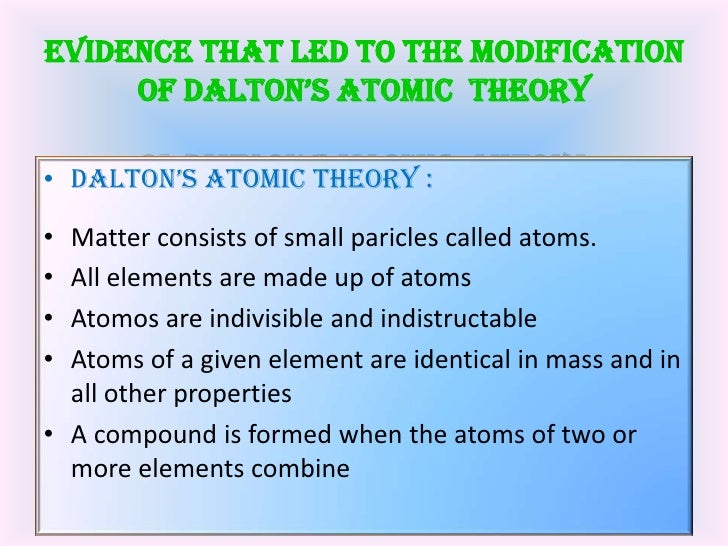
Recently we started a new chapter in chemistry all over Atomic Structure and Radioactivity. We covered a new scientist, John Dalton, who proposed his own theory, Dalton's Theory. He was a baseline for future scientists to further build off of his ideas, including JJ Thomson.
JJ Thomson came around when technology was in a full swing. He was able to use a cathode ray tube to show the atoms of any element emit particles with a negative charge, or he discovered electrons. A best way to describe Thomson's model would be a chocolate chip cookie. The dough would equal the sphere, and the chocolate chips would equal the electrons.
http://media-1.web.britannica.com/eb-media/72/22472-004-3E9C843B.jpg


Then Rutherford came along and proved that there was a presence of a positively charged center in an atom, or the nucleus. 
With all these scientists contributions over the years, we have come up with the current atomic model used for today.
http://d1jqu7g1y74ds1.cloudfront.net/wp-content/uploads/2010/02/c-atom_e1.gif